

flmp · The Human Layer — Developing Potential
flowmapping has been developing as a way to work with situations that are not yet fully defined: an opportunity someone wants to explore, a challenge with several connected dimensions, an idea that needs more context before it becomes a project, or simply the question of what a useful next move could be.
Much of that development initially happened from our side, working with maps, categories, questions and physical materials. But a framework reaches a different point when other people begin using it with situations of their own — bringing contexts, assumptions, ambitions and constraints that were never part of its development environment.
That is where this Context Log begins.
The first substantial material comes from Uganda, where students connected to Nkumba University are now working with flowmapping through group sessions, individual conversations and their own work between them. Nkumba is the first practical setting, not the boundary of this log. What interests us is what begins to happen when the framework meets different people, different contexts and questions that matter to them.
Chapter One · Uganda
The first sessions at Nkumba University in Uganda, were not built around presenting a finished tool and asking students to apply it correctly. We introduced some of the underlying ways of looking at an environment, an opportunity and the factors surrounding it, and then began working with the situations and interests participants brought with them.
Several group sessions were followed by reflection, 1:1 conversations and a working brief of around five pages. The brief combined observations, context and questions intended to take the work beyond a first collection of ideas. Participants then returned to their own research and exploration.
Practical learning here is not about learning flowmapping for its own sake. It begins with something that matters to the participant.
The framework helps investigate that situation more thoroughly, question assumptions, recognise relevant actors and resources, understand local conditions and decide what may be worth pursuing further. For some, that may eventually mean entrepreneurial activity and income. Another pathway may develop into research, a community initiative, a collaboration or a project within an existing organisation.
Others may change direction once the context becomes clearer. The destination is not predetermined. The work is in making the next direction more informed.
From interest to opportunity
One of the current pathways explores how an existing connection to agriculture, land and entrepreneurship can develop into something more concrete. Having a tangible starting point helps, but it does not automatically provide a project or business model.
Her initial work explored Uganda-specific aspects of beekeeping and agriculture, including possible business opportunities, small-scale entry, products beyond honey, training, market access and examples of organisations already operating in the country.
Rather than asking her to cover more subjects, the next feedback asked her to select two or three areas she had already identified and investigate them more deeply. What does a particular opportunity actually look like in Uganda? Which company, cooperative, programme or organisation provides a concrete example? Where is the practical challenge? What can be observed locally? And what might somebody looking at the same subject from outside Uganda misunderstand?
The work then returns to her. She decides what to investigate, finds material and local perspectives, relates them to her own circumstances and brings something more specific into the next conversation. The next round of guidance can respond to what she has actually discovered rather than moving her through a predetermined sequence.
At the time of writing, this pathway is still developing. Beekeeping may become part of it, another agricultural activity may prove more relevant, or several opportunities may begin to connect. The point is not to force an early answer. It is to make the opportunity increasingly concrete before deciding what deserves to move further.
From learning to leverage
Once someone begins examining an opportunity seriously, the surrounding environment starts entering the picture. In an agricultural pathway this can include farmers and land, training providers, cooperatives, buyers, existing businesses, local organisations, infrastructure, community knowledge and people who already know through experience what works and what does not.
At that point, learning and implementation are no longer completely separate.
A student may begin with research and discover a viable entrepreneurial direction. Another may identify a community need for which an existing organisation becomes relevant. A research question may lead to a small practical pilot. Something initially considered as a business may reveal a stronger social or environmental dimension, while a community challenge may contain an economic opportunity that had previously gone unnoticed.
This is where leverage becomes tangible.
For some participants, the possibility of generating income is not an abstract measure of success. It can affect their own choices and opportunities, contribute to family income and, over time, change what becomes possible for the people around them. Other pathways may create leverage through knowledge, access, collaboration or community impact.
None of these outcomes is promised. But they are important reasons why practical learning should not necessarily end when the learning activity ends.
Guidance without taking over
Working with the first pathways has also made the balance between guidance and ownership much more concrete.
If we provide every source, define every question and prescribe every next step, the resulting work may become more polished while telling us less about what the participant herself can recognise and develop. If we provide too little structure, a broad opportunity can remain broad for a very long time.
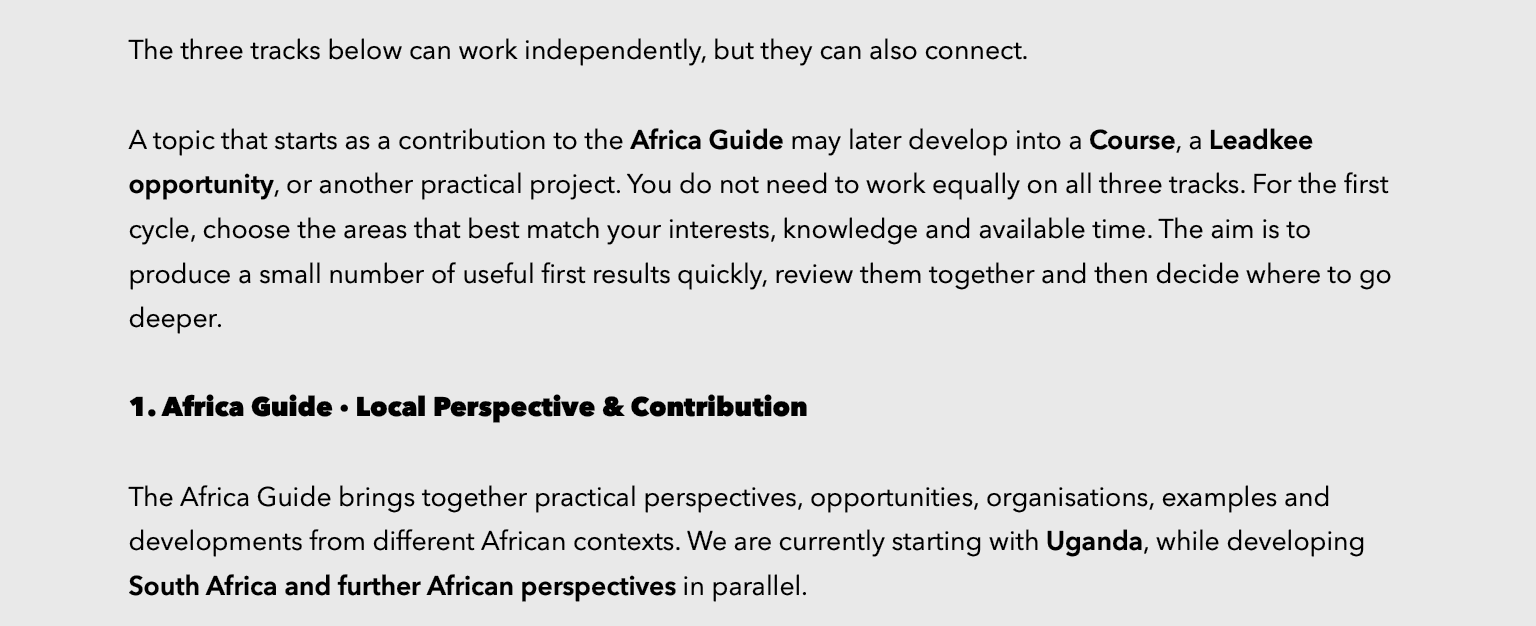
Excerpt from the Working Brief used for the first contribution cycle.
flowmapping sits somewhere between those extremes. A map can help separate dimensions of a situation. A question can expose an assumption. Feedback can identify where something deserves another round of investigation. A conversation can reveal a connection that was not visible in the material alone. The pathway remains theirs. That becomes particularly important if practical learning is expected to continue beyond a workshop, classroom or supervised session.
The stories between the sessions
A pathway does not stop when a session ends. Research may happen several days later. A conversation with somebody locally may challenge an earlier assumption. A new organisation may appear relevant. Something that looked promising may become less convincing — or suddenly much more concrete.
Participants therefore have their own individual online- working area within the I&I Studio environment, where they can return to flowmapping guidance and practice tools, access working material, view or upload files and continue developing their pathway between sessions.
The immediate purpose is continuity: keeping those discoveries connected to the pathway rather than scattering them across meetings, messages and individual files. The workspace is developing alongside this work. What becomes useful in practice can be observed before we decide what the environment needs next.
Between sessions · video
A glimpse into the working space where individual pathways continue to develop.
What one pathway can bring back
The value of this work does not stop with the individual participant.
When several students investigate their own environments, they also bring material back into the university: local observations, organisations, business realities, community questions, implementation barriers and opportunities that may not have been visible in the original session. A shared session can provide a common starting point while the subsequent work moves in very different directions. Those pathways can later return to supervision, discussion or research with new practical material attached to them.
Connections can also extend beyond the university. Local organisations or practitioners may become relevant to a pathway. A business may contribute practical expertise or a challenge worth examining. A faculty may discover that several apparently unrelated student interests touch the same local issue. An individual project can reveal something useful for a wider community.
From individual pathways to shared capacity.
The first participants have begun bringing people from their own circles into their respective tracks. Rather than opening entirely separate directions, they are joining around the same focus — an early example of how individual connections can create, extend and multiply shared capacity.
Not every pathway needs to become a startup, and academic work does not need to become commercial. What becomes interesting is what can happen when learning, entrepreneurship, research, community knowledge and implementation are allowed to meet around an actual context.
What practical use reveals
Practical use gives us something internal development cannot: observation. A term we considered obvious may require clarification. A question may work differently in a facilitated session than when someone encounters it alone. A category that works naturally on paper may require another approach on screen. Those observations give us evidence for our continued development of flowmapping and the environments in which it is provided. The method itself remains deliberately consistent across individual applications.
Live workshop online-sessions with students in Uganda, conducted over several days.
Built to travel beyond screens and desks
flowmapping was never intended to depend on a screen. Direct conversations, 1:1 guidance and workshops are equally important ways of working with the framework. They allow questions to develop through interaction, assumptions to surface and perspectives to shift in ways that cannot always be designed into a digital sequence.
At the same time, the process should not depend on someone else being present. One of the strengths we are exploring is the connection between guided work and self-directed reflection: looking inward at assumptions, experience, emotions and ways of thinking, while looking outward at people, resources, relationships, constraints and opportunities in the surrounding context. What begins in a conversation or workshop can continue independently — and what emerges independently can return to the next conversation.
Alongside these human forms of interaction, the digital workspace and developing web app, we have created a paper-based version of the framework. It can support individual reflection, facilitated sessions and collaborative work, including environments where personal devices, reliable internet access or other digital resources cannot be assumed. The physical materials can also be made available for licensed use within university, organisational and other collaboration settings.
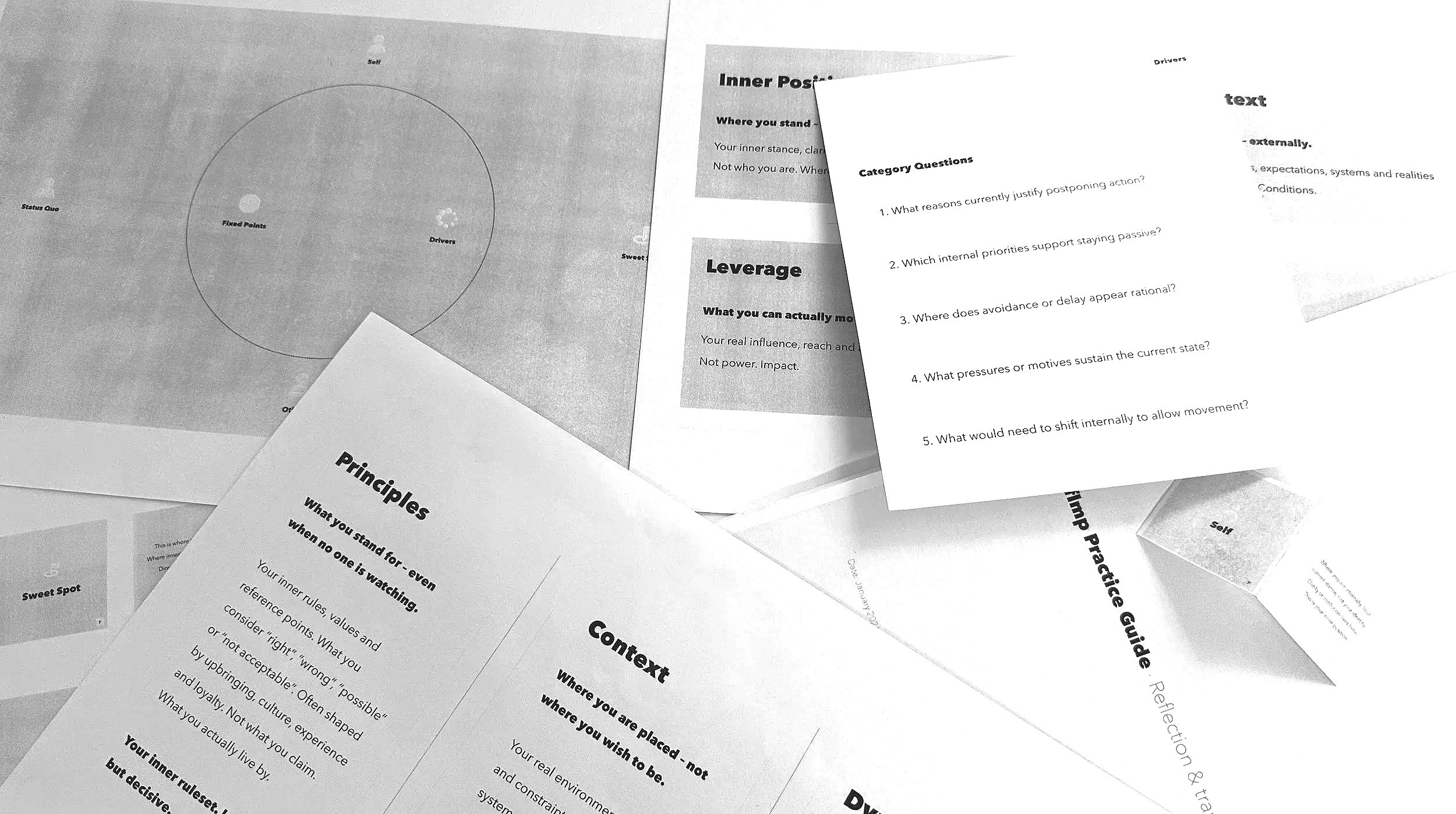
Part of the paper-based flowmapping set.
The context we carry
The human layer is also a cultural one.
Two people can enter the same situation and see different opportunities, different constraints and different reasons to act — or not to act. Context is not only what surrounds us. We carry part of it with us. Experience, social environment, expectations, emotions and learned ways of thinking can influence what becomes visible, what feels possible and what may be dismissed before it is explored.
Working across cultural, institutional and other environments makes some of those differences easier to encounter. The purpose is not to assign characteristics to countries or cultures. It is almost the opposite: different perspectives can expose assumptions that remain invisible when a situation is viewed from only one familiar position.
This is also beginning to open another direction for flowmapping. In current conversations with companies, we are exploring its relevance in cross-cultural business and people-development settings — environments in which behaviour, collaboration, decision-making and innovation cannot be understood through processes and external conditions alone.
International teams, organisational change and service environments are obvious areas to explore further. Not because flowmapping provides a cultural formula, but because it can create a structured way to look at what different people bring into the same situation. As flowmapping moves between different cultural, institutional and economic environments, this is one of the dimensions we want to observe much more closely.
What deserves to become digital?
We are developing the first small browser-based flowmapping application alongside this practical work. The objective is not to reproduce every paper element on a screen. An Area Map can help preserve and reorganise a changing picture of a situation. Guidance can remain available between sessions.
One Move can capture what follows from a round of work, while a MapCard can make an intermediate result easier to revisit and share. Other parts may continue to work better through conversation, physical materials, local observation or time spent away from an interface. Our observations from practical use will help us decide what deserves to become software — and what should remain deliberately human, physical or conversational.
Connecting contexts
Uganda is among the first places where these elements are beginning to connect in practice: repeated sessions, individual pathways, local research, feedback and continued work between meetings. It is an early opportunity to observe flowmapping outside the environment in which it was developed.
Other contexts are already beginning to open. But connecting contexts is not simply about adding more of them. We have also learned that extensive preparation, expressed interest and even a seemingly clear path towards implementation do not necessarily mean that a collaboration will move forward. In one case, substantial work had already gone into preparing a joint implementation before the process revealed that some of the commitments needed to carry it forward could not be relied upon in practice.
That matters too.
A framework can help make opportunities and pathways clearer, but implementation still depends on agreed contributions being carried through in practice. Sometimes the important next move is therefore not implementation, but knowing when not to continue.
Universities bring different disciplines, students and local environments. Organisations and companies bring existing challenges, teams and implementation realities. Cross-cultural work adds another human dimension. Individual pathways may move towards income, research, community impact or something that was not visible at the beginning. The interesting part will not be whether all of these contexts produce the same result. They should not. It will be what becomes visible when the same underlying method begins travelling between them.
This log will follow that movement — through new pathways, physical and digital applications, different settings, further observations and the things that do not work as expected.
These are among the first pathways we can follow as they unfold. Other contexts are already beginning to connect.
From Curiosity to Connection to Change · If this note sparked a thought or a new perspective, we’d be delighted to continue the conversation. Every exchange, collaboration and contribution helps build meaningful connections across cultures.