

Working Boundary · A distinction.
This text outlines a working boundary and an operational architecture currently being implemented across education, livelihood, and field contexts.
Where this architecture actually begins
This architecture does not begin with vision.
It begins with work. With real conditions. With responsibility. With systems that must carry — ecologically, socially, and economically. Beekeeping is neither a project nor a symbol.
It is a stress test. A field in which it becomes visible whether collaboration works, whether responsibility is truly taken, and whether impact can be sustained over time. Bees do not negotiate. They respond to structure, continuity, and care. That is precisely why they are suitable as a foundation for a larger architecture.
What emerges here is not a beekeeping program, but an operating framework. It is a way of working, cooperating, and scaling that must prove itself in real environments: in rural regions, in communities, in partnerships between people, organizations, and markets.
This architecture addresses people who are not looking for concepts, but for systems that hold. Partners who are willing to take responsibility — in education, operations, mediation, or market access.
And those who do not understand beekeeping as an isolated activity, but as part of a larger fabric of learning, income, and dignity. Beekeeping is introduced only once local structures are ready to carry it. The work precedes the tools.
This architecture is not an open offer.
It presupposes a specific working and practice-based stance. The following distinction is not a value judgment, but a working boundary.
This is not for you if you…
need clearly defined responsibilities before taking responsibility
see alignment as a prerequisite for action
expect role, title, or mandate before contributing
orient primarily through feedback
tend to be present rather than deliver
expect structure instead of creating it
separate thinking from doing
interpret ambiguity as a leadership failure
prioritize optimization over initiative
seek coherence where momentum is required
This is for you if you…
take responsibility as a starting point
act before everything is clarified and refine through practice
create structure through contribution
integrate thinking, doing, and learning
work reliably without instruction
understand ambiguity as a space for shaping
value contribution over position
remain committed even without visibility
can work with fragmentation
think in longer arcs of impact
What participation concretely means here
This architecture does not function through roles, titles, or programs.
Participation emerges through contribution. Those who continue take responsibility before it is formalized. There are no predefined paths and no guaranteed positions. Work arises from real requirements, not from task descriptions.
Those who engage operate in open systems. Information is not always complete. Decisions are made in action and refined along the way. Learning is not a preliminary step, but a byproduct of doing. This mode of work requires autonomy, reliability, and the ability to engage productively with uncertainty.
This architecture does not replace income and does not absorb individual risk. It amplifies what already carries. Those who work within it bring their own ground — professional, economic, or structural — and use the architecture to increase impact, reach, and depth. Partnership here does not mean delegation of tasks, but coupling responsibility between independently carrying actors.
What this architecture gives back
What emerges is not a promise, but a resonance space.
Those who contribute gain access to real fields of impact: to communities, projects, and learning environments that are lived, not simulated. Relationships do not form through positioning, but through carried responsibility. The architecture connects local realities with international contexts. It creates access to networks where learning, research, entrepreneurship, and social practice interlock.
Visibility does not arise through self-presentation, but through continuity. Trust grows from repeated contribution.
For many, this accelerates their own development — professionally, structurally, and personally.
For some, it expands their existing work or business.
For others, it remains a learning space that brings clarity — including about their own limits.
Possible lines of participation
Participation does not follow fixed roles, but becomes visible along recurring lines.
Some contribute through learning and mediation — in training, educational formats, or university contexts.
Others work closer to operational realities, within projects, communities, or field structures. Others again connect research, documentation, and translation across cultures, systems, and forms of knowledge.
There are contributions in building partnerships, opening markets, and translating between social and economic logics. And there are those who develop digital, organizational, or structural systems to enable transparency, scalability, and connectivity.
These lines are not offers, but observations. They emerge where people take responsibility and begin to build viable connections. This inner work connects with external structures. The architecture therefore links dignified livelihoods, education-based pathways of advancement, women-led communities, and ecological cycles that are both locally rooted and globally connected.
Income, education, and dignity are no longer treated as separate domains, but as interdependent systems.
Observable impact in practice
These outcomes arise as a consequence of continuous work within this architecture.
Initial results are visible:
women-led livelihood clusters where income, education, and dignity intersect
learning spaces across multiple regions in India that integrate ecological and pedagogical models
emerging student movements across continents — learning, research, participation
growing micro-systems linking ecological income, leadership training, and digital transparency
How this architecture manifests in practice can be observed in specific locations.
Impact in Northern India
In Sakri, we have been working for three years with a small school that has gradually developed into a stable point of reference for children, parents, and the surrounding community. What began as an educational initiative now reaches further — beyond the children, into families and local structures.
Learning, responsibility, and community are visibly interwoven. This work is part of an extended learning and exchange space. As part of a multi-week international internship, several project locations were engaged — including Sakri and other sites, as well as urban contexts such as Kolkata.
The focus was not observation, but contextual understanding and contribution:
How do education, local responsibility, and economic perspectives interrelate across different realities?
From 2026 onwards, such internships will again be possible at multiple locations. Beekeeping is being deliberately integrated into this existing fabric. Initial hives form part of the next development stage, with further hives to be built and carried jointly with the community. We collaborate with experienced partners who bring operational practice, training, and development work from different regions.
The goal is to connect education, income, and responsibility in ways that create structures capable of lasting beyond individual projects. In such constellations, we do not exclude taking responsibility ourselves for build-up and scaling.
This example does not represent a promise, but a working method.
Impact emerges where development proceeds step by step, local responsibility is strengthened, and systems do not grow faster than they can be carried.
The flmp Layer
flmp (flowmapping) is introduced in parallel, grounded in the existing educational work. The local school, supported and financed over the past three years, serves as a living reference point — not as a pilot, but as a stable learning environment. flmp connects learning, reflection, responsibility, and decision-making across education, livelihood, and community structures, step by step.
It provides a shared meaning layer for inner orientation and outer action — creating clarity and coherence under fragile social and life conditions. At the same time, it links local development with pathways into wider society, including education and vocational trajectories.
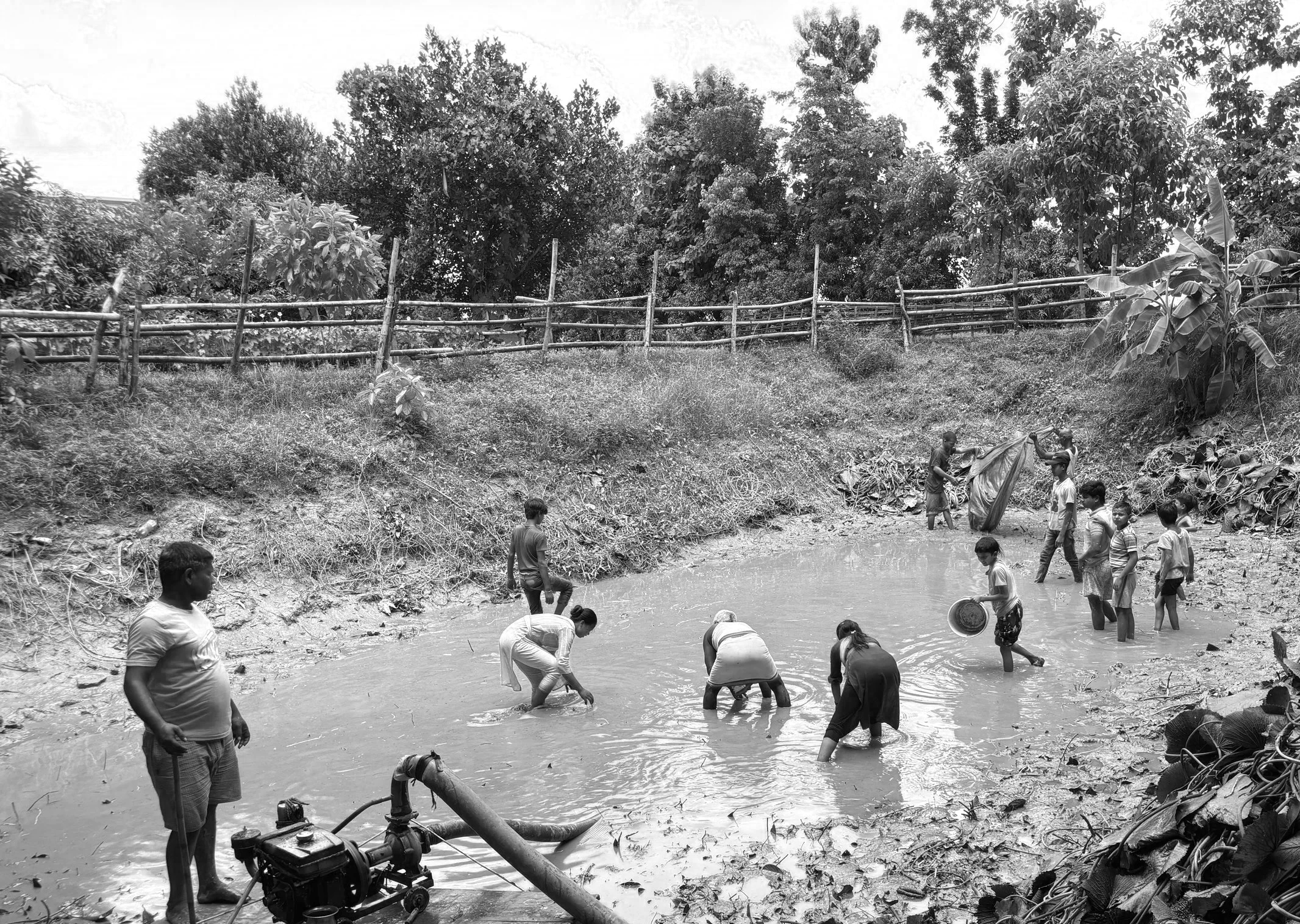
Sakri Field context.
Working Threshold
This is not an invitation in the classical sense.
It is a threshold.
Those who reach out should not ask what is needed here, but what they already carry.
Not who they are, but what they are working on.
Not what they are seeking, but where resonance or friction emerges.
Contact does not arise through application, but through alignment.
We assess whether this architecture carries.
And equally, whether it can be carried.
Both matter equally.
Further visual context is occasionally shared on LinkedIn →
www.linkedin.com/in/sumanthhaussmann