

yuu Studio · From Potential to Practice
How individual exploration can become research, collaboration and practical outcomes – and open pathways beyond them.
Potential rarely arrives as a finished project. It may begin with an interest, an observation, a question or simply the sense that something could be explored further. Universities and organisations bring together many people with this kind of potential. What is often more difficult is creating enough space around an individual direction for it to develop beyond a first conversation, workshop or assignment.
The yuu Innovation & Implementation Studio works in this space. It provides a flexible structure in which an initial direction can be explored through research, individual guidance, feedback and exchange, and can gradually connect with other people, knowledge, tools or implementation opportunities.
There is no predetermined outcome. A contribution may remain a focused piece of research. It may become a concept, a publication, a market or organisational analysis, a prototype or the starting point for further collaboration. The purpose is not to move everyone through the same programme, but to create enough continuity for promising directions to develop.
From the Human Layer to practical work
In an earlier Context Log, flmp · The Human Layer — Developing Potential, we looked at some of the first individual pathways emerging through Studio sessions in Uganda. The focus was deliberately on the human layer: interests, perspectives and capabilities that may not immediately be visible through institutional roles or predefined project structures.
One of these pathways has since moved considerably further.
An initial interest in beekeeping developed into focused research around the practical question of how small-scale production in Uganda can connect with quality, value addition and access to markets. A first investigation provided a basis for Studio feedback. Rather than closing the work at that point, the feedback opened additional questions: Where can value be lost between the hive and the customer? What does a producer need beyond production itself? How important are handling, processing, packaging, standards and reliable buyers? And how could somebody begin with limited resources rather than assuming an established commercial operation from the outset?
Further investigation followed. The material and sources were subsequently reviewed through the Studio and developed editorially into a contribution for the Africa Guide. The contributor then reviewed that version from a Ugandan perspective, identifying areas where the realities of small producers, access to training and equipment, reliable buyer relationships and gradual growth needed to become more explicit. These observations became part of the next editorial version. Following a final contributor review, the resulting content version was confirmed, completing this first research and editorial development cycle.
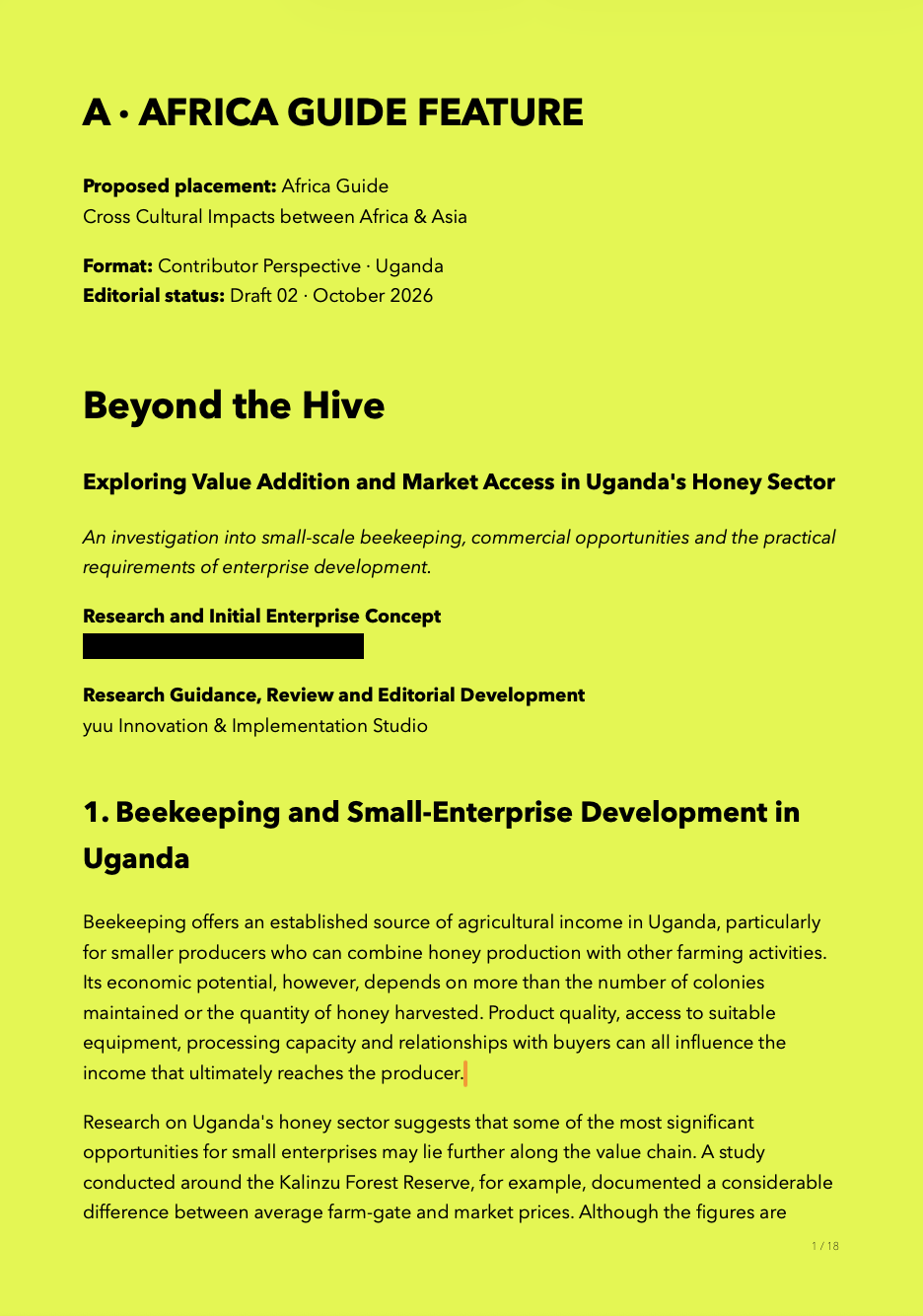
Uganda contributor research · Studio guidance and editorial development · developed for the Africa Guide
The resulting feature, Beyond the Hive – Exploring Value Addition and Market Access in Uganda’s Honey Sector, does not claim that a business has already been implemented or that a particular enterprise model has been commercially validated. It represents something different: an initial direction has become a structured and increasingly practical contribution through several stages of independent work, feedback, further investigation and editorial development.
The value lies as much in this process as in the resulting article.
A structure that can adapt
This case illustrates how an institutional framework can provide the foundation for focused and flexible work to develop within it.
This case illustrates how an institutional framework can provide the foundation for focused and flexible work to develop within it. Once that basis is established, not every individual pathway needs to become a separate institutional programme. The Studio can work directly with emerging interests and opportunities, while the wider collaboration provides context, continuity and a basis for further development.
The structure can remain lightweight. A Work Log can document the initial direction, agreed tasks, contributions, Studio guidance and feedback, important developments and resulting outcomes without reproducing every conversation or turning the collaboration into another administrative process.
This also makes the approach transferable without assuming that the same model should simply be copied elsewhere.
We are currently discussing with different actors in several African contexts how such collaboration could work within their respective environments. The starting points vary. In one context, student research and entrepreneurship may be particularly relevant; elsewhere the stronger connection may be to community development, applied research, innovation structures, companies or existing institutional initiatives.
The question is therefore not how to reproduce one Uganda case in another country. It is what already exists locally, where an additional connection could create value, and what combination of people, research, methods, tools and implementation support is useful in that particular environment.
The same applies beyond Africa. Current conversations and collaborations across India, Southeast Asia and other regions bring very different institutional, economic and cultural contexts into the Studio. This creates opportunities not only to develop work locally, but also to connect perspectives where there is a genuine reason to do so.
And then?
A research contribution does not necessarily have to end with publication.
It can lead into further work around the same subject, into a related course or research question, or into exchange with people exploring comparable issues elsewhere. In other cases, the next connection may be quite different.
The Studio is already working on technology and implementation projects that create additional points of entry. Research into organisations, markets or local conditions can, where relevant, connect with these projects. Other pathways may develop through open collaboration projects currently being discussed with universities, researchers, organisations and companies in different countries.
Leadkee Social, for example, provides a separate pathway for investigating organisations and companies, market entry, local partnerships and the intersections between commercial and social activity. Other Studio work can involve digital tools, cross-cultural research, implementation concepts or collaboration between contributors in different locations.
These are not predefined next steps for every contributor. Nor does each initial piece of work need to grow into something larger. They form a wider corridor of possibilities around the Studio: a contribution can stand on its own, continue within its subject, connect to an existing project, or create an unexpected link to another person, institution or place.
That openness is intentional.
The Studio provides structure where structure helps, but does not require the destination to be known at the beginning. A first exploration can become a tangible outcome. And once something tangible exists, it can also become a new starting point.
These are among the first pathways we can follow as they unfold. Other contexts are already beginning to connect.
From Curiosity to Connection to Change · If this note sparked a thought or a new perspective, we’d be delighted to continue the conversation. Every exchange, collaboration and contribution can become a starting point for further development and new connections.