

Cross-Cultural Connections · Between the Lines
Alphabet • Buddhism • Bridges
Exploring the shared heritage of India and Thailand.
The relationship between Thailand and India stretches back thousands of years. Long before modern borders existed, merchants, monks and settlers from the Indian subcontinent travelled to Suvarnabhumi – the ancient Land of Gold in Southeast Asia. Their journeys were driven by trade, but they also carried ideas, philosophies and religions such as Brahmanism, Hinduism and Buddhism.
Along with these cultural influences came something even more fundamental: writing.
One of the earliest examples is the Pallava script, originating in South India. Evidence of its presence can still be found in Thailand through the famous Pallava inscriptions. Over time, this script became the foundation for many writing systems across Southeast Asia, including those of present-day Myanmar, Cambodia, Laos, Lanna and ultimately Thailand itself.
Bangkok
The Journey of an Alphabet
A remarkable example of this cultural exchange is the King Chit Sen inscription, preserved today in the National Museum of Ubon Ratchathani. Written in an early form of the Pallava script, it illustrates how a South Indian writing system gradually evolved into the prototype for several Southeast Asian alphabets.
Rather than remaining confined to one region, the script travelled across borders together with merchants, monks and scholars, shaping written communication throughout the region.

Bangkok, Thailand
Language and Lasting Influence
Thai belongs to the Tai–Kadai language family, a language group very different from the Indo-European languages of the Indian subcontinent.
Nevertheless, modern Thai contains a remarkable number of loanwords from Pali and Sanskrit. These words entered Thailand primarily through the spread of Buddhism and other Indian religious traditions.
Because Pali and Sanskrit were regarded as sacred and prestigious languages, many of their words became part of royal vocabulary, official terminology, literature, religious texts and place names. Their influence remains visible in contemporary Thai society.
The only known seated Ardhanarishvara sculpture in Southeast Asia
National Museum, Ubon Ratchathani, Thailand
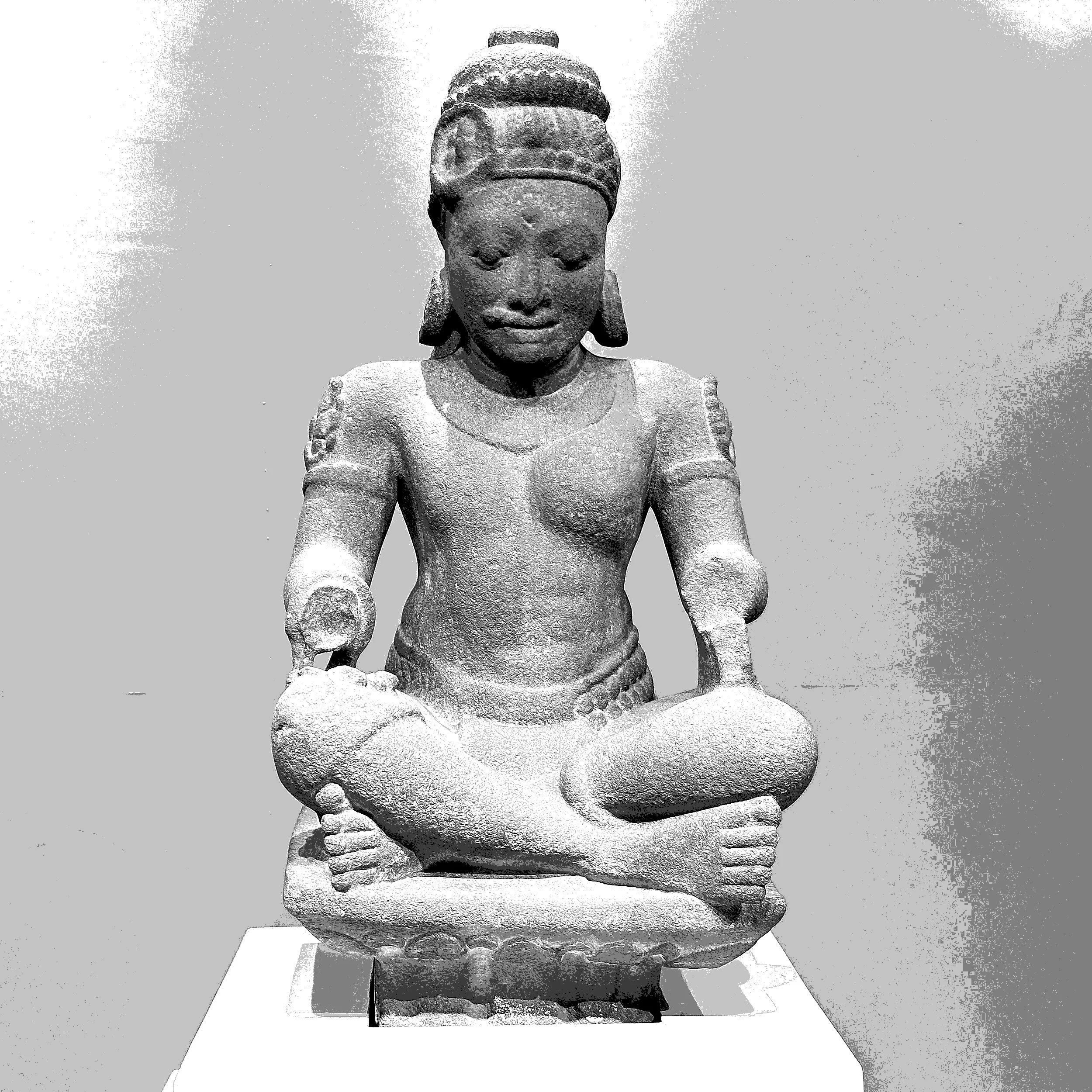
A Rare Cultural Treasure
The only known seated Ardhanarishvara sculpture in Southeast Asia
National Museum, Ubon Ratchathani, Thailand
Pali and Sanskrit
Unlike Thai, which generally relies on word order and particles rather than grammatical inflections, Pali and Sanskrit are Indo-European languages with complex grammatical structures.
As a result, their influence on Thai is found primarily in vocabulary, rather than grammar. Thai remained structurally a Tai language while enriching its lexicon with thousands of words of Indian origin.
Religious and Cultural Connections
Thailand is widely recognised as a Buddhist nation, and stories from the life of the Buddha, the Jataka tales and Buddhist teachings continue to shape many aspects of Thai culture and tradition.
One well-known example reflects a gesture of profound respect.
According to Buddhist tradition, when Prince Siddhattha returned to Kapilavastu after attaining enlightenment as the Buddha, his wife Yasodhara (also known in some traditions as Phimpha) bowed before him and gently wiped his feet with her hair.
This symbolic act of humility and reverence later found echoes in Thai culture.
A historical example is Princess Dara Rasami, daughter of the ruler of Chiang Mai and consort of King Rama V. Before returning to Chiang Mai for several months, she is said to have let down her long hair and respectfully brushed the King’s feet with it as a final expression of honour before her departure.
The connections between India and Thailand are therefore not limited to trade routes or religious history. They continue to be reflected in language, writing, traditions and everyday life—reminding us that cultures often remain connected long after the journeys that first brought them together have ended.
Historical reflections by a Thai archaeologist, translated and presented as part of an ongoing cross-cultural exchange.
From Curiosity to Connection to Change · If this note sparked a thought or a new perspective, we’d be delighted to continue the conversation. Every exchange, collaboration and contribution helps build meaningful connections across cultures.